
Short answer: A 250V, 500V and 1000V insulation tester should be selected by the circuit, equipment and procedure, not by the largest number on the dial. Fluke's official information for the 1507 lists insulation test voltages of 50V, 100V, 250V, 500V and 1000V, plus live-circuit detection above 30V, auto-discharge and CAT IV 600V overvoltage protection. The Meterenhanced listing identifies the Fluke 1507 and includes a remote probe. Those facts describe the instrument, not permission to test any circuit. Use the applicable procedure, prove isolation where required and keep competence boundaries clear.
What the three test voltages mean
The numbers are test-voltage options, not a simple quality ranking. Fluke lists 250V, 500V and 1000V as part of the 1507's available insulation test voltages, alongside 50V and 100V. The correct choice depends on the equipment, circuit and applicable procedure; a higher setting is not automatically better.
A buyer should therefore compare the tester with the work instructions already used by the responsible electrician or organisation. Do not select 1000V merely because it is the highest listed option, and do not infer a pass value without the relevant standard, manufacturer instruction or test plan.
| Setting | Official Fluke listing | Buyer implication |
|---|---|---|
| 250V | One listed insulation test voltage | Confirm when the equipment procedure calls for it |
| 500V | One listed insulation test voltage | Do not assume it is correct for every domestic circuit |
| 1000V | One listed insulation test voltage | Use only where the applicable procedure permits it |
| Other listed options | 50V and 100V are also listed | The range is broader than the search phrase alone |
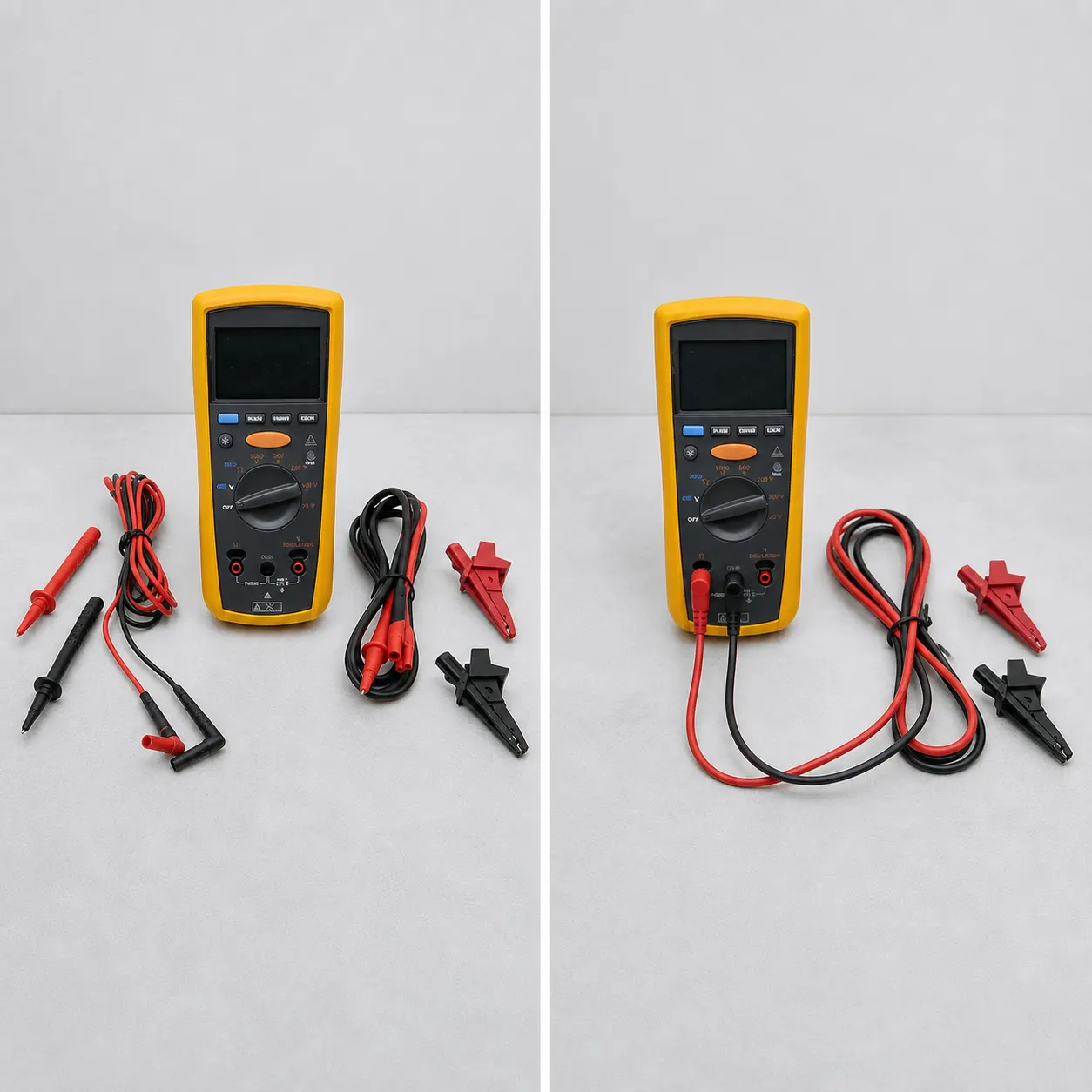
Prepare the test boundary first
Insulation testing can apply a deliberate test voltage to the item under test. HSE electrical-safety guidance places emphasis on preventing danger and using suitable equipment and procedures. The Fluke 1507's live-circuit detection above 30V is a protective feature, not proof that a circuit is safe to touch or that every source of energy has been removed.
Follow the site's safe-isolation process and the equipment manufacturer's instructions. The remote probe may help with a hard-to-reach test point, but it does not remove the need to control the circuit, leads, test area and people nearby.
- Identify the equipment and the authorised test procedure before choosing 250V, 500V or 1000V.
- Isolate and secure the circuit in accordance with the applicable site process.
- Prove the test arrangement and leads are suitable, intact and connected to the correct points.
- Keep people clear, apply the test and allow the instrument's discharge function to complete.
- Record the result with the test voltage, equipment identity and any required follow-up.
Read the useful features without overclaiming
Fluke lists live-circuit detection above 30V, auto-discharge of capacitive voltage, CAT IV 600V overvoltage protection and 200mA lo-ohms earth-bond continuity. Those are useful specification points for comparing an insulation tester, but they do not replace a risk assessment, a safe-isolation procedure or an interpretation of the result.
The Meterenhanced page identifies the Fluke 1507 and includes a remote probe with a test button. The product listing does not turn that accessory into a guarantee of access, accuracy or compliance for a particular installation.
Limits and checks before buying
The Fluke 1507 may suit an electrician or maintenance team whose documented work calls for its listed test-voltage range and functions. Confirm the supplied leads, probes, battery arrangement, current calibration status and the organisation's required records before relying on a particular unit.
Do not describe the tester as an EICR certificate, a guarantee of compliance or a substitute for competent electrical work. HSE guidance remains the boundary for safe working. If the procedure, competence or circuit condition is uncertain, stop and obtain the appropriate responsible person.
Related guides and product details
Choose 250V, 500V or 1000V from the authorised test procedure, then verify the Fluke 1507 package and safe-isolation arrangements before work. Read Best Insulation Tester for a Domestic Electrician for related guidance. Read Insulation Resistance Tester for EICR Work in the UK for related guidance. Review the documented specification on the Fluke 1507 insulation resistance tester product page before ordering.
Sources and safety context
- Supports the listed Fluke 1507 identity and included remote probe. Current Meterenhanced Fluke 1507 product page.
- Supports the listed test voltages, live-circuit detection, auto-discharge, CAT IV 600 V and 200 mA continuity functions. Fluke 1507 Insulation Resistance Tester.
- Supports the need for suitable electrical equipment, procedures and competence boundaries. Electricity at work: safe working practices.